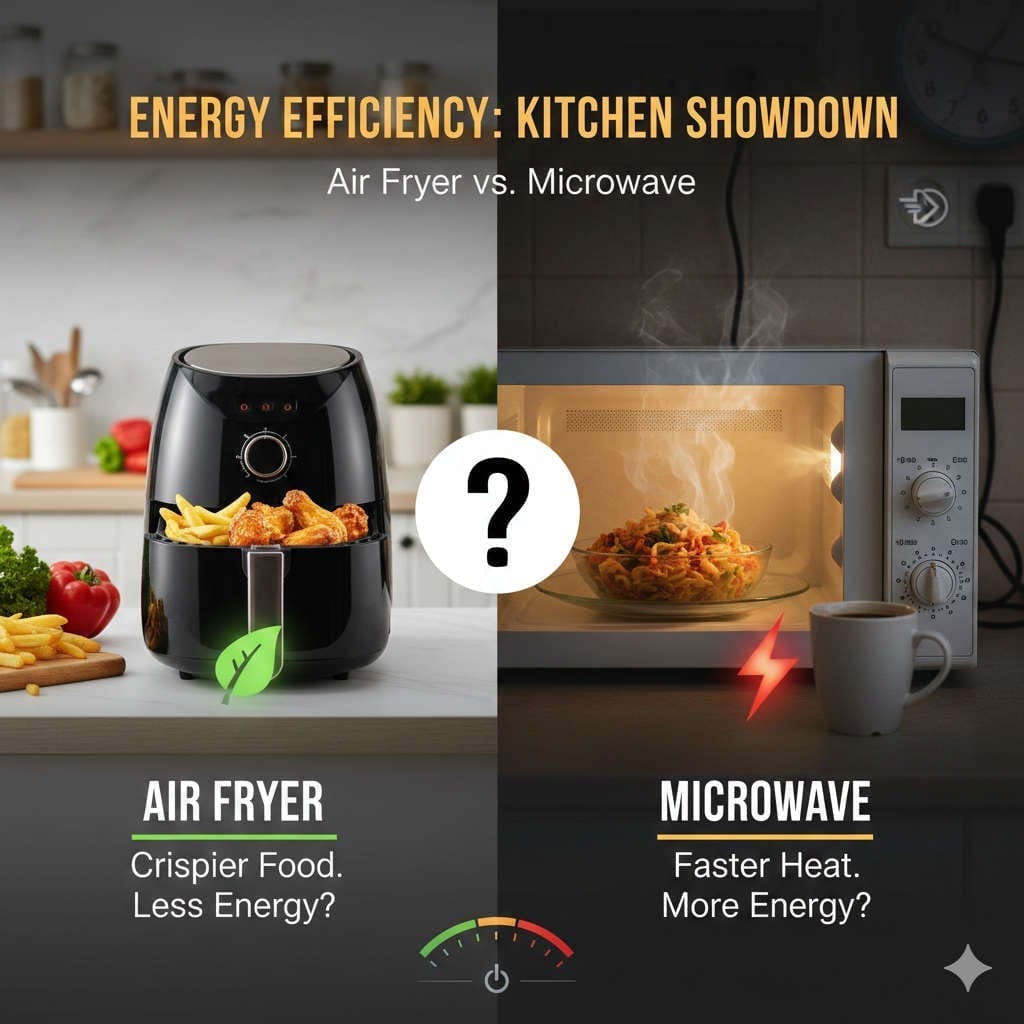
Energy efficiency has become a central concern for modern households. Rising electricity costs, environmental awareness, and the desire to run smarter kitchens are pushing people to rethink how they cook their daily meals. Among the most commonly used countertop appliances today are the air fryer and the microwave oven. Both promise speed, convenience, and versatility, yet they operate on very different principles and consume energy in distinct ways.
This raises a practical and often debated question: which is more energy efficient, an air fryer or a microwave? The answer is not as simple as choosing one appliance over the other. True efficiency depends on how each device works, how long it runs, what type of food is being prepared, and how often it is used.
This in-depth guide explores energy efficiency from every relevant angle. It explains how each appliance uses electricity, compares real-world energy consumption, discusses cost implications, and helps you decide which option aligns best with your cooking habits. The goal is not just to declare a winner, but to give you the knowledge needed to cook smarter, save money, and reduce unnecessary energy use.
Understanding Energy Efficiency in Kitchen Appliances
Before comparing appliances, it is important to understand what energy efficiency actually means in the context of cooking. Energy efficiency is not simply about how powerful an appliance is or how many watts it consumes. Instead, it measures how effectively electrical energy is converted into useful cooking heat.
An appliance that uses more watts but cooks faster may consume less total energy than one that runs at lower power for a longer time. Efficiency is therefore determined by the relationship between power consumption, cooking duration, and heat loss.
In practical terms, energy efficiency affects three key areas. It influences your electricity bill, your kitchen’s heat output, and your overall environmental footprint. Appliances that waste less energy generate less excess heat, reduce demand on power grids, and cost less to operate over time.
With this framework in mind, we can now take a closer look at how air fryers and microwaves actually function.
How Air Fryers Use Energy
An air fryer is essentially a compact convection oven designed for speed. It uses a heating element combined with a high-powered fan to circulate hot air rapidly around food. This intense airflow creates a crisp exterior while cooking the interior thoroughly.
Because air fryers are relatively small and enclosed, they heat up faster than traditional ovens. However, they still rely on heating air first and then transferring that heat to food. This indirect method of cooking is important when evaluating energy use.
Most air fryers operate within a power range of approximately 1200 to 1800 watts. Smaller models may sit at the lower end of this range, while larger basket-style or oven-style air fryers tend to consume more power. During operation, the heating element cycles on and off to maintain the set temperature, while the fan runs continuously.
Although air fryers cook faster than full-sized ovens, they still require a sustained period of high heat. Preheating, even if brief, adds to total energy consumption. The hot air circulation also means some heat escapes through vents, contributing to energy loss.
Despite these factors, air fryers are often considered efficient compared to ovens because they cook faster and heat a smaller space. The question is whether that efficiency holds up when compared to microwave ovens.
How Microwaves Use Energy
Microwave ovens work in a fundamentally different way. Instead of heating air or surfaces, microwaves use electromagnetic waves to excite water molecules within food. This molecular vibration generates heat directly inside the food, rather than transferring it from an external heat source.
This direct heating process is the primary reason microwaves are widely regarded as energy efficient. Very little energy is wasted heating the surrounding air or the appliance itself. Most of the electricity consumed is used to heat the food directly.
Typical household microwaves operate between 600 and 1200 watts, with many standard models averaging around 900 to 1000 watts. Unlike air fryers, microwaves do not require preheating. The moment the appliance is turned on, energy is being used to cook the food.
Microwaves also tend to run for shorter periods of time. Reheating leftovers, steaming vegetables, or cooking simple meals often takes only a few minutes. This combination of lower power and shorter runtime generally results in lower total energy consumption per use.
However, microwaves have limitations. They do not brown food, and they can heat unevenly. While this does not affect energy efficiency directly, it influences how often people rely on other appliances instead.
Comparing Energy Consumption in Real-Life Cooking Scenarios
Theoretical efficiency is useful, but real-world usage provides a clearer picture. Energy consumption depends heavily on what you are cooking and how long the appliance runs.
When reheating leftovers such as pasta, rice, or soup, a microwave usually completes the task in two to three minutes. An air fryer, even at its fastest setting, may take eight to ten minutes to heat the food evenly. Because the air fryer operates at higher wattage for a longer duration, it consumes significantly more energy for this task.
Cooking frozen foods highlights another contrast. Frozen vegetables or ready meals are often designed with microwave instructions because microwaves can defrost and cook efficiently in one step. Air fryers, while capable of cooking frozen foods, require longer times and higher temperatures to achieve proper results.
Even when preparing fresh vegetables, the microwave often finishes cooking in half the time required by an air fryer. Steaming broccoli or carrots in a microwave can take five to seven minutes, while roasting them in an air fryer typically takes ten to fifteen minutes.
In nearly all basic cooking scenarios, microwaves use less total electricity. This does not mean air fryers are inefficient devices, but it does indicate that microwaves excel in tasks where speed and direct heating matter most.
Cooking Time and Its Impact on Energy Efficiency
Cooking time plays a crucial role in determining energy efficiency. Even small differences in runtime can significantly affect electricity usage over months or years of regular use.
Microwaves are designed for speed. Their ability to heat food from the inside out allows them to complete tasks quickly. Shorter runtimes translate directly into lower energy consumption, even if the appliance operates at high power.
Air fryers, by contrast, must maintain a consistent temperature to cook food evenly. This requires sustained energy input. Although modern air fryers are well insulated and optimized for airflow, they cannot match the speed of microwaves for simple heating tasks.
Over time, these differences add up. A household that relies heavily on an air fryer for reheating or basic cooking may see higher electricity usage compared to one that primarily uses a microwave for those tasks.
Electricity Costs Over Time
To understand how energy efficiency affects household budgets, it helps to look at long-term electricity costs. While the cost of a single cooking session may seem negligible, frequent use compounds expenses.
Microwaves typically consume around 0.05 to 0.15 kilowatt-hours per use, depending on duration and power level. Air fryers, on the other hand, often consume between 0.2 and 0.5 kilowatt-hours per session.
If an appliance is used daily, these differences become more noticeable over the course of a year. Microwaves generally cost less to operate, making them the more economical choice for frequent, short cooking tasks.
That said, energy costs vary by region and electricity rates. In areas with high energy prices, choosing the most efficient appliance can make a meaningful difference in monthly utility bills.
Heat Output and Kitchen Comfort
Energy efficiency is not just about electricity consumption. It also affects kitchen comfort, especially in warm climates or small spaces.
Microwaves generate minimal ambient heat. Because most of the energy is absorbed directly by the food, the surrounding air remains relatively cool. This reduces the need for additional ventilation or cooling.
Air fryers release hot air through vents during operation. While they produce less heat than full-sized ovens, they still warm the kitchen more than microwaves. In summer months, this added heat can indirectly increase energy use by placing additional demand on air conditioning systems.
From a comfort and secondary energy use perspective, microwaves have a clear advantage.
Cooking Quality Versus Energy Efficiency
While energy efficiency is important, cooking quality also matters. This is where air fryers often justify their higher energy use.
Air fryers excel at producing crispy textures, browning, and roasted flavors. Foods like fries, chicken wings, and roasted vegetables benefit from convection cooking. Microwaves simply cannot replicate these results, regardless of efficiency.
For many households, the air fryer replaces a conventional oven for smaller meals. When compared to oven use, the air fryer is often the more energy-efficient option. The comparison becomes less favorable only when measured directly against microwaves.
This highlights an important point: energy efficiency should be evaluated within context. An air fryer may use more energy than a microwave, but less than an oven. Choosing the right appliance for each task maximizes overall efficiency.
Appliance Size and Capacity Considerations
The size of an appliance also affects its energy performance. Smaller microwaves and compact air fryers generally heat up faster and use less energy per cycle.
Oversized appliances cooking small portions waste energy by heating unused space. This applies particularly to air fryers with large baskets. If you frequently cook single servings, a smaller unit is typically more efficient.
Microwaves scale more effectively for small portions, making them ideal for individual meals or snacks. For larger batches, energy use increases, but still often remains lower than comparable air fryer sessions.
Matching appliance size to cooking needs is an overlooked but important factor in improving energy efficiency.
Environmental Impact and Sustainability
Reducing electricity use contributes to environmental sustainability, especially in regions where power generation relies on fossil fuels. Lower energy consumption means fewer emissions and reduced strain on energy infrastructure.
Microwaves generally have a smaller environmental footprint due to their lower energy use per cooking session. Over years of daily use, this difference can translate into a meaningful reduction in household emissions.
Air fryers, while less efficient than microwaves, still offer sustainability benefits when they replace energy-intensive cooking methods like deep frying or conventional oven baking.
The most environmentally responsible approach is not necessarily choosing one appliance exclusively, but using each efficiently and appropriately.
Tips to Improve Energy Efficiency in Daily Cooking
Maximizing energy efficiency does not require sacrificing convenience or food quality. Small changes in habits can yield noticeable savings.
Using the microwave for reheating and basic cooking tasks is one of the simplest ways to reduce energy use. Reserving the air fryer for foods that truly benefit from crisping helps balance efficiency and enjoyment.
Avoiding unnecessary preheating, especially with air fryers, reduces wasted energy. Cleaning appliances regularly ensures proper airflow and heating efficiency. Cooking multiple items at once, when possible, also minimizes repeated energy use.
Selecting appropriate power levels and temperatures further improves efficiency. Higher settings are not always faster or better and may lead to overcooking or wasted energy.
Choosing the Right Appliance for Your Lifestyle
The decision between an air fryer and a microwave should reflect how you cook, not just energy statistics.
If your cooking routine involves frequent reheating, quick meals, and simple food preparation, a microwave is the most energy-efficient choice. It saves time, costs less to operate, and keeps kitchen heat to a minimum.
If you value texture, flavor, and versatility, an air fryer adds significant culinary benefits. While it uses more energy than a microwave, it may still be an efficient alternative to traditional ovens.
Many households find that owning both appliances offers the best balance. Using each where it performs best results in overall energy savings and better cooking outcomes.
The Final Verdict on Energy Efficiency
When comparing air fryers and microwaves purely on energy efficiency, the microwave consistently emerges as the more efficient appliance. Its direct heating method, shorter cooking times, and lower power requirements make it ideal for everyday use.
However, energy efficiency should not be viewed in isolation. Air fryers provide cooking capabilities that microwaves cannot match and can be an efficient replacement for ovens in many situations.
The most efficient kitchen is one where appliances are used thoughtfully. By understanding how each device consumes energy and applying that knowledge to daily cooking decisions, you can reduce electricity use, lower costs, and still enjoy great food.
In the end, the smartest choice is not choosing one appliance over the other, but knowing when to use each for maximum efficiency and satisfaction.